
What to Do First When You Are Served With a Restraining Order
Oct 27, 2026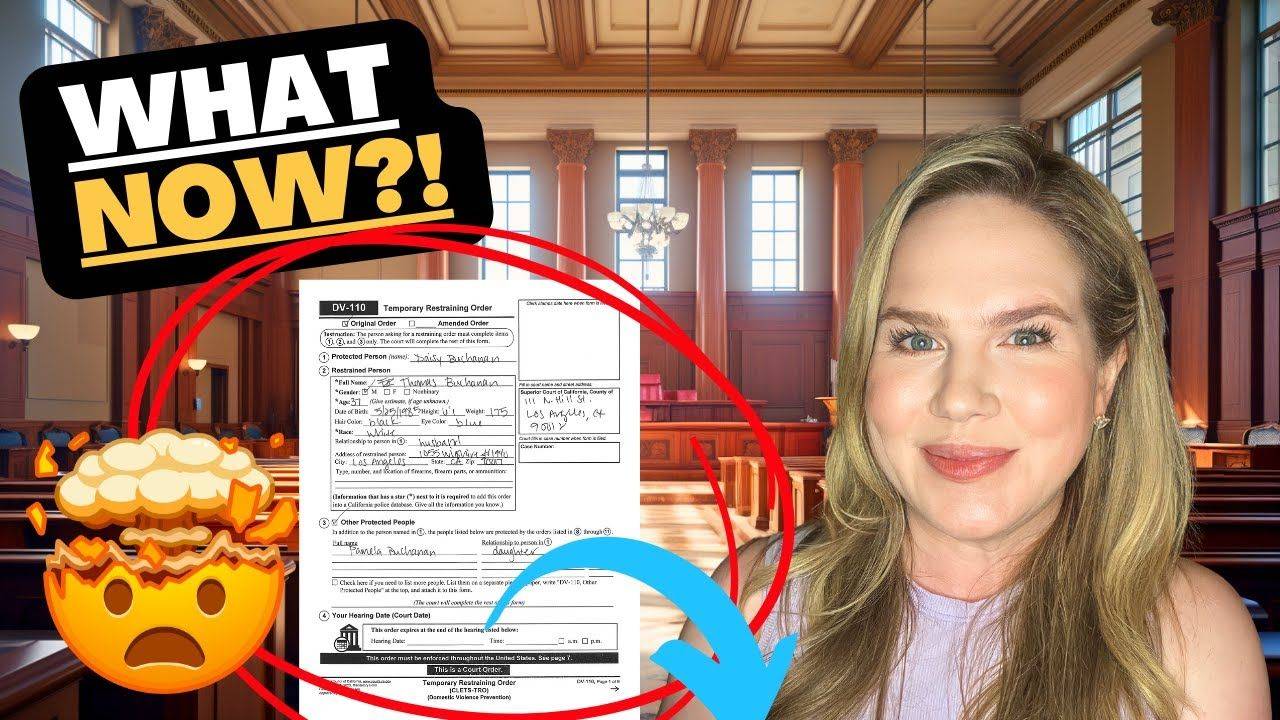
By Veronica T. Barton, California domestic violence defense attorney and creator of DEFEAT the DVRO
The short answer
Don't panic. Read the whole restraining order all the way through, then read it a second time for the hearing date and for what the court actually ordered, and put the hearing date in your calendar right away. Then go through it a third time and type out the allegations, scan every document clearly, and keep each document saved as its own file. Organization and preparation are key to winning your hearing.
What to do when you first get served
I am a domestic violence defense attorney here in California, and I help people put their cases behind them so that they can enjoy their lives and their freedom. In this post I will explain what to do as soon as you get that temporary restraining order, how to read it, and what your immediate next steps should be as you prepare to win and defeat this thing.
Step 1: Read the whole thing all the way through
If you are reading this, you may have already done this. Read the whole thing all the way through. This is going to start the wheels turning in your mind about what is true, what is a lie, and how to defeat it.
Lesson 1.2 of DEFEAT the DVRO, “How to Read a Restraining Order,” covers this in more detail.
Step 2: Read it a second time for the key details
You have read the whole thing, maybe not in great detail, and you have an idea of what they are saying. Next, read it a second time and look at a few key details.
Find the hearing date
First, look for the hearing date. The hearing date is on a document that says DV-109 in the upper left-hand corner, and it says "Notice of Court Hearing." It says that a court hearing is scheduled on the request for the restraining orders against the person, which is you if you were served with it. It will say the date, the time, the room, and the name and address of the court.
Put that in your calendar right now. Hopefully you use the calendar app on your phone, have all the reminders, and check it regularly. Make sure that you do not forget and that you don't let that date slip past.
Check what was ordered
Second, look at what was ordered. A temporary restraining order can include a variety of different orders, and you want to see exactly what the court said you have to do or avoid doing. This is important because the petitioner might have asked for certain things that the judge did not grant.
Look at the temporary restraining order itself. DV-110 is the court order, which the court prepared. Maybe the petitioner filled out some initial information, but the court fills this out itself.
Look for anything that says "denied until the hearing"
Go through each number and see if anything was checked. If anything says "denied until the hearing," that is important, because it means the judge doubts something about either the petitioner's story or what the petitioner is asking for. Look through for anything that says that, and make a note of it.
Maybe the petitioner is asking, for example, for someone to be protected or for you to stay away from a certain place, but it is not clear why they are asking for that. Then the judge might select "denied until the hearing."
If the judge selects "denied until the hearing" on, for example, number 10, the no contact order, then the judge is casting doubt on the veracity of the petitioner's story. The judge at the hearing is probably not the same judge who reviewed this, but a judge looked at this and thought, "That sounds weird," because normally they are going to grant everything.
Pay attention to anything "granted as follows"
Pay attention to anything that says "granted as follows," for example number 11, stay away. Where do you have to stay away from? It may be places that are very difficult for you to stay away from, but if you violate this, it is a criminal offense. A violation is also a basis for the judge to grant the restraining order at the hearing for up to five years. Even if it is very inconvenient and horrible for you, as I know it is for many people in this situation, make sure that you abide by it.
The order to move out
That includes number 12, order to move out. Unfortunately, this is one of the key reasons why people file these restraining orders in the first place. They want the other party to move out. If you receive one of these at your home, you have to leave, and hopefully you have someone that you can stay with. If the restraining order ultimately isn't granted at the hearing, you can move back in, but you still have to move out immediately. That is one of the major hardships that come with these restraining orders.
Child custody and visitation
If you have children, look at number 14, child custody and visitation. This is another major reason why people file these things: to get a leg up on custody cases. If the two of you are getting divorced, one of you will go see a divorce lawyer, and the first thing they do is suggest filing one of these restraining orders, even if there was no abuse. The default in California is 50/50 custody, but many people want more than that, and this is one of the only ways to get it.
Step 3: Go through it a third time and type out the allegations
Step three for how to read a restraining order is to go through it a third time and type out the allegations. I'm not saying type out the whole form. I'll give you an example. For each allegation, go to number 6 on the DV-100. Type out the date and type out the witness. The date is listed on A, and the witness is listed on B.
The reason is that this is so messy. The tip I'm giving you is something that I do as an attorney. I know it may seem like a pain, but this is one of my secret weapons, not just to defeat people who don't have an attorney but to defeat other attorneys.
This is one of multiple allegations. During the hearing, trying to flip through and read this messy handwriting is very difficult and very inefficient. While you do that, you will not be able to listen and pay attention to what is going on, which is important.
When you are preparing your case, you want to be able to pull these allegations apart one by one. For each allegation that we dispute, we ask what evidence we have, or what my side of the story is. When it is all a mess in the other party's handwriting, that is very difficult to do.
If you type it all out, you can do a search. I would ultimately type out every single thing that was written in here. Then if I want to know what the petitioner said happened on Black Friday, for example, or on December 25th, or what it was about the bottle of whiskey, all I have to do is type in "whiskey" or "December 25th" or "Black Friday." I can very easily find that, no problem.
Or I might think, "Wait a second, didn't she say in her paperwork that he hit her in the face, and now she is saying instead that he grabbed her arm? Let me find that." I can find it in a second if I have it typed out on my computer.
Scan the entire document, clearly
Next, I suggest scanning the entire document. If you have to do a phone scan, you can, but use an app like Turbo Scan and do a good job. You don't want to be using bad pictures. Make sure that everything is very clear and easy to find. If you ever need to refer to these documents in court, or if the judge refers to a document and you have everything scanned in as one long document, it will be very difficult to locate it.
Keep each document as its own file
The last thing I ever want to be doing in court is flipping through pages looking for something. If it is electronic, I save the DV-110 temporary restraining order as one file and the DV-100 as another file. If I need to refer to one of them, I don't need to look through all of the DV-110 just to get to the DV-100.
To do this, look at the top of each document. I know you are served with a lot of them. Look at the upper left-hand corner, where it says DV-100. That is one document. Separate each document and save them separately. If you have physical copies, keep them separate as well.
Organization and preparation are key to winning any type of litigation, including this restraining order. As a first step to prepare, type everything out and make sure that you feel nice and organized. This is so important to avoid feeling overwhelmed and to ultimately win your hearing.
Frequently asked questions
What should I do first when I'm served with a restraining order?
Read the whole thing all the way through. Then read it a second time and look at a few key details, starting with the hearing date and what the court actually ordered. Put the hearing date in your calendar right away and don't let that date slip past.
Where do I find the hearing date on a restraining order?
The hearing date is on the document that says DV-109 in the upper left-hand corner, "Notice of Court Hearing." It will say the date, the time, the room, and the name and address of the court. Put it in your calendar right now.
What does "denied until the hearing" mean on a temporary restraining order?
It means the judge doubts something about either the petitioner's story or what the petitioner is asking for. If the judge selects it for something like the no contact order, the judge is casting some doubt on the veracity of the petitioner's story. Look through the DV-110 for anything that says that, and make a note of it.
What happens if I violate the stay away order?
If you violate it, it is a criminal offense. Violations are also a basis for the judge to grant the restraining order at the hearing for up to five years, so even if it is very inconvenient, you want to make sure that you abide by it.
Why should I type out the allegations?
Messy handwriting is very inefficient to flip through during the hearing, and you won't be able to listen and pay attention while you do. If you type it all out, you can search it, pull the allegations apart one by one, and quickly find what the petitioner said.
Where this fits in DEFEAT the DVRO
You can keep binge watching YouTube hoping to find the answers on how to win your restraining order hearing, or you can get them served to you on a silver platter, which is exactly what I do in my course, DEFEAT the DVRO. It is a self-paced video course for respondents who plan to represent themselves. Step 1, "Understand What the Judge Is Looking For," covers how to read a restraining order, and the full course has 25 short lessons in 6 steps plus a fill-in Respondent Workbook, with about 2 hours of video.
If you have a restraining order hearing coming up, take the free first class. You have literally nothing to lose. It is about 19 minutes, with no credit card required, and it covers how to ask for a continuance, what to print and bring, rereading the other side's papers, what is at stake, and the five-part strategy. The full course is $596, or 4 payments of $149 with Klarna, with lifetime access and a 48-hour money-back guarantee.
Start the free class at defeatthedvro.com
This post is educational and is not legal advice. Reading it does not create an attorney-client relationship.